

Serene Elegance in Magenta
The First of March
Subtle Awakening Keeps Unnamed Reverence Alive
Fujisawa, Japan, 5:30 am. The light came into my room at the 8 Hotel, and on my bed I lay still for a moment, aware of it without yet being willing to acknowledge it.
There is a kind of dishonesty one practices in the interval between waking and rising — a pretence that the day has not yet made its claim, that one remains sovereign over these few suspended minutes. I have always been susceptible to it. But the light on this particular morning came in undiluted through the window — sixth floor, the entire southern sprawl of the city laid out below in the pale early clarity — and it pressed itself against my closed eyes with such quiet insistence that I understood, even before I opened them, that this was not a day that would permit postponement.
I rose. I dressed. I checked the battery on the camera, the drone, the spare. Rituals before an adventure — small, unhurried, entirely necessary — and had a quick, delicious complimentary breakfast.
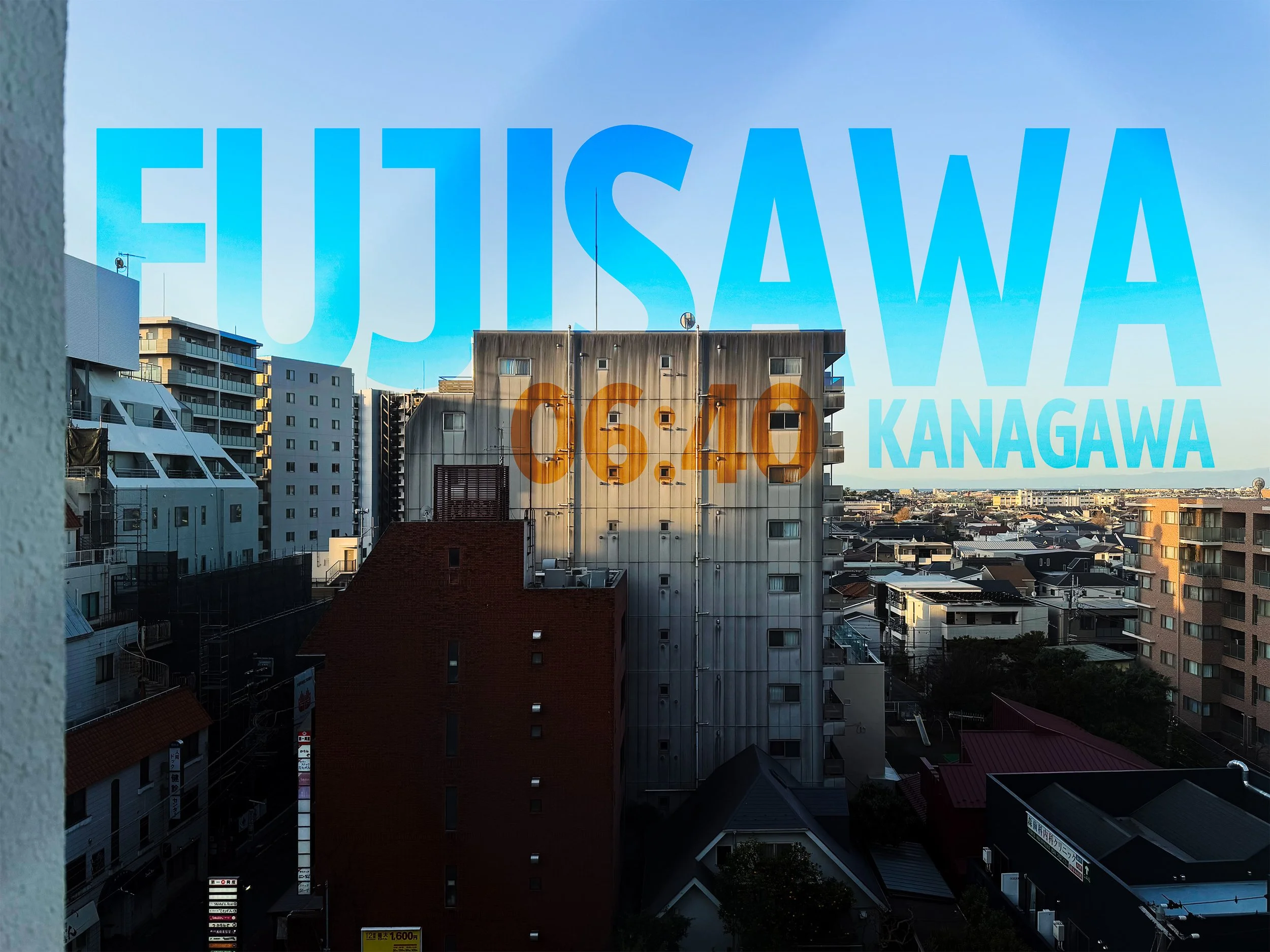
Outside, Fujisawa was still asleep. The streets were nearly empty, the air carrying a mildness that the calendar had not promised, as though March had decided, on its very first day, to be generous. I had a train to catch, and somewhere south to be. I did not yet know, precisely, what was waiting — only that something was, and that the light agreed.
This is the hour when a foreign city most completely reveals what it is — when the scaffolding of commerce and routine has not yet been erected, and the place exists simply as itself, without performance. I have had occasion to think about this often, in the early mornings of a great many cities across a great many years. For a decade now I have lived this way — without fixed address, moving through East and Southeast Asia with a camera and the kind of patient, accumulated curiosity that only sustained proximity to a place can generate.
I have learned languages — eight of them, of which five I use with regularity, the other three serving a different purpose: not daily conversation, but access — to a culture's interior, to the way a people think and feel before they translate those thoughts for others. Recently, I have been learning Japanese intensively, and it is perhaps the most demanding undertaking I have set myself — a language that asks not only for new vocabulary and script, but for an entirely new architecture of thought; a different sense of where meaning sits in a sentence, of what is said and what is deliberately left unsaid.
I do not say any of this as a boast but as an explanation, because language — far more than grammar and vocabulary — is the deepest record a culture leaves of itself. The way a people speak tells you how they grieve, how they celebrate, how they conceive of time and beauty. Even countries that share the same language reveal, in the details, how differently the same words can live: English alone fractures into a dozen distinct worlds — the pronunciation, the idiom, the emotional temperature of the same phrase spoken in London, Singapore or Sydney — each version carrying an entire history inside it that no translation can carry across. This is why I have kept moving for a decade. Not to collect countries, but to collect the ways the world means things.
Thailand to Vietnam, Indonesia to Taiwan, China, India or Korea — each has given me something I could not have anticipated. But Japan is different. Japan has always been different. Of all the countries I have returned to, it is the one that continues to withhold something — not directly, not with hostility, but with the quiet patience of a place that knows it has more to offer than any single visit, or any ten visits, can drain. Its culture runs too deep, its traditions too carefully tended, its history too densely layered for any outsider to feel, after even many years, that they have reached the bottom of it. This is not frustrating. It is, I have decided, the precise definition of a place worth coming back to.
I walked to the station in that candid early light and boarded the train bound south-westward, and the city released me in the manner of something that had never particularly needed me to begin with.
For three hours the train moved along the coast, where Kanagawa gradually concedes to Shizuoka, and I sat with my face turned toward the window — feeling, as I always do on long train journeys through this country, the peculiar sensation of being simultaneously in motion and profoundly still.
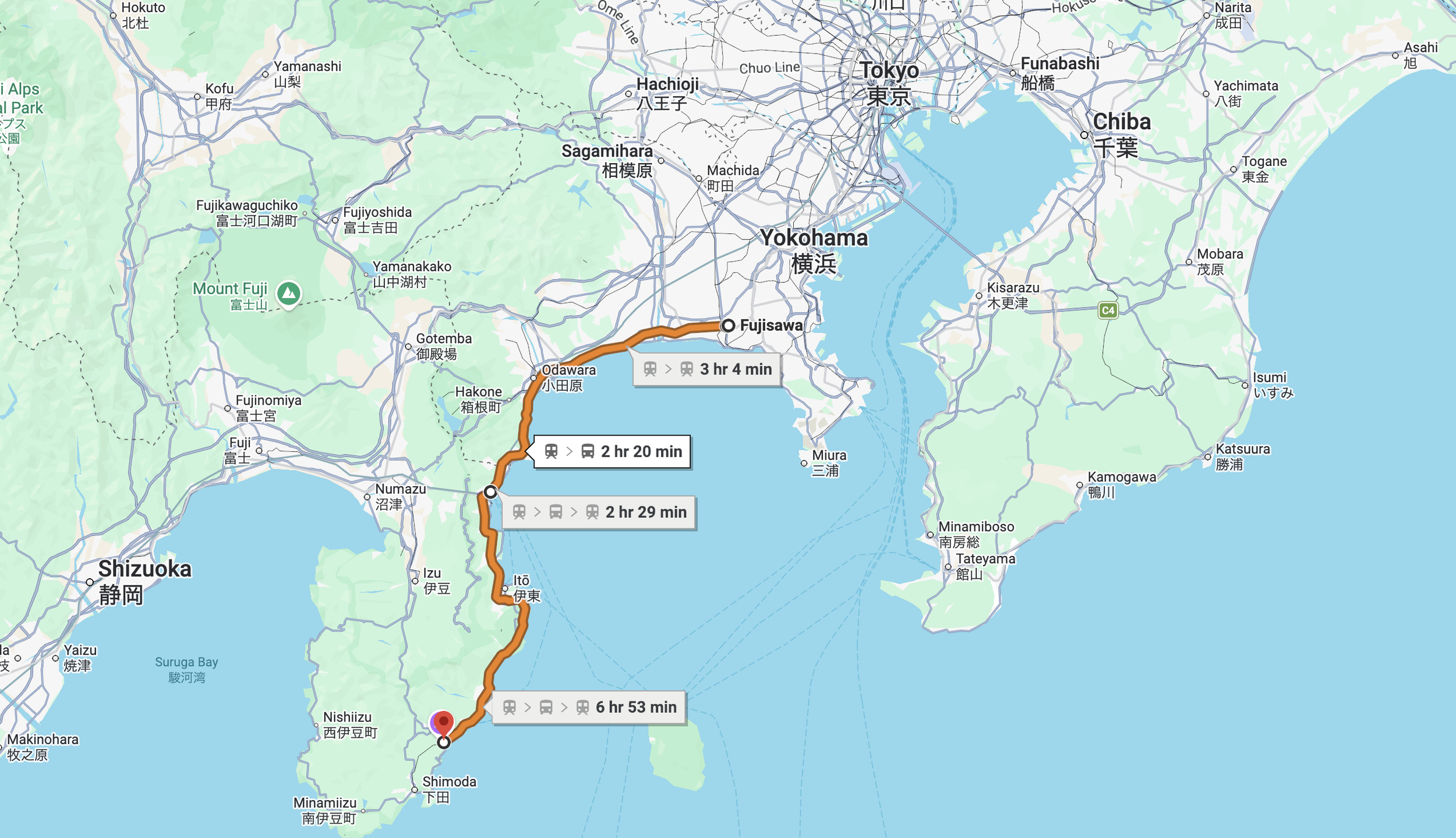
The sun was already well above the horizon, casting the long, low light of a winter not yet fully relinquished — laying itself across the sea and turning the water to hammered silver, finding the eastern faces of every hill and holding them with a warmth the air itself had not yet earned. Fishing villages appeared and vanished. Pine-covered headlands presented themselves briefly and were taken away. I watched all of it with the attention one brings to things one knows one will not see again in exactly this way.
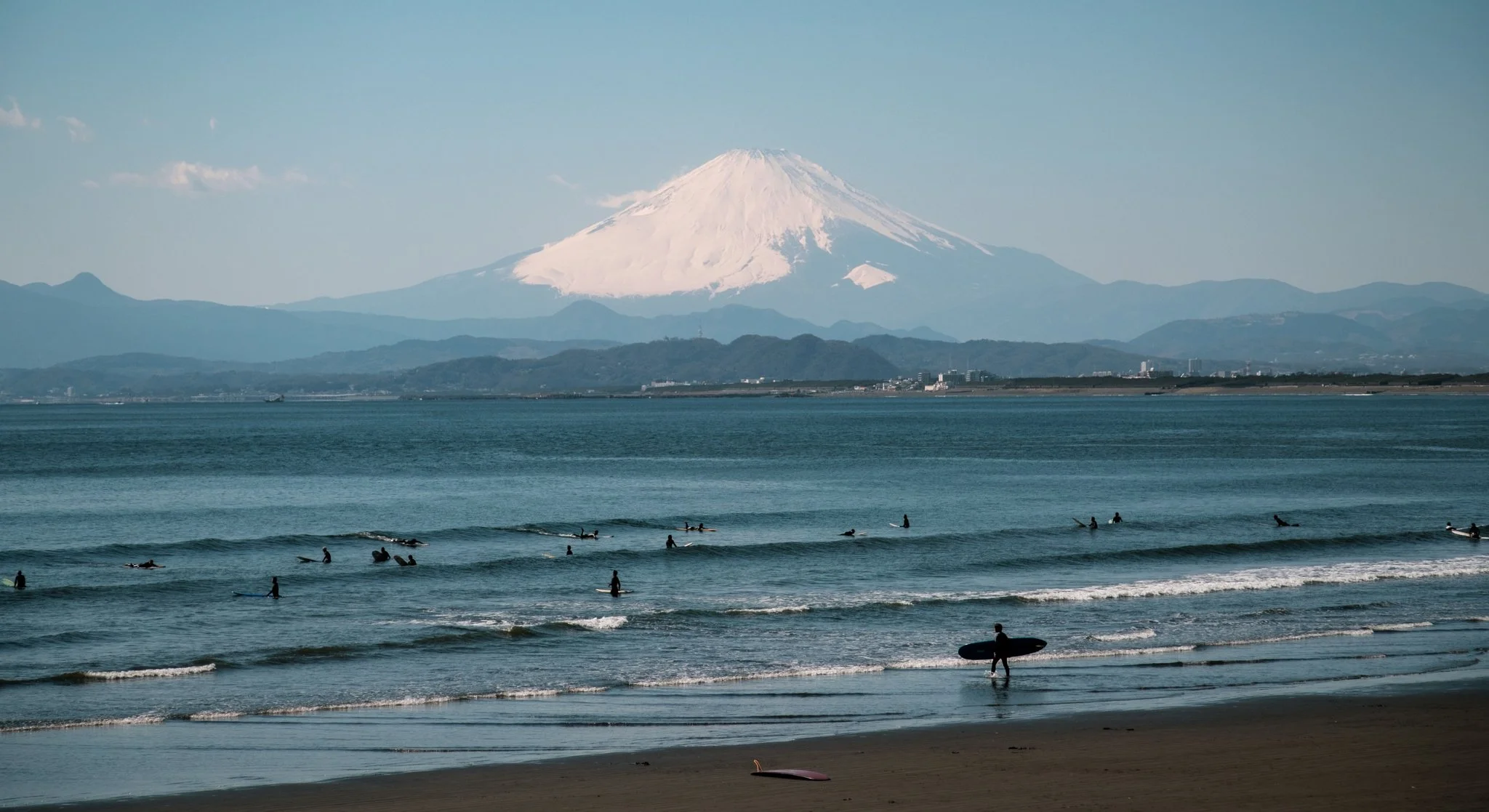
And then Mount Fuji appeared.
He stood proudly to the north, vast and unhurried, his summit carrying its snow with the indifference of something that has been doing so for longer than human memory can reach. I pressed my face toward the glass.
For the Japanese, this mountain is not simply a geographical superlative — not simply the highest peak in the archipelago, though it is that, at nearly four thousand metres, with the kind of solitary dominance that leaves no room for argument. It is something older and less rational than a record. Fuji has been sacred for centuries — a site of pilgrimage, a dwelling of gods, a mountain that appears in the oldest poems and the most contemporary convenience store calendars with identical respect, as though the culture understood from the beginning that here was something which would not diminish with familiarity. Its symmetry is almost too perfect — that clean, volcanic cone rising from the plain with a geometric serenity that seems less like an accident of geology than a considered gesture. The Japanese have always sensed something intentional in it. Something that watches.
I first saw him in 2019, on my second journey to Japan. I cannot account, even now, for what happened in that first encounter — the way the mountain seemed to reach across the distance and take hold of something interior. I have stood before many mountains, have photographed peaks across the region from clear dawn to driving rain, and felt, each time, the appropriate elevation of spirit that great altitude reliably produces. But Fuji produced something else. Something more private and less explicable. I am not a person given easily to mysticism, and I resist the vocabulary of the inexpressible — and yet I find, each time I attempt to describe what this mountain does to me, that the ordinary vocabulary fails, and I am left with the inadequate but honest admission that it simply does.
He does not demand reverence. He simply makes the absence of it feel inadequate.
I sat with that inadequacy for some time, as the train continued south and the mountain slowly, almost reluctantly, withdrew behind the hills.
The coast glittered. I thought about nothing in particular. The morning deepened around me.
I arrived in Kawazu at ten, the sun already high and unambiguous in a sky that had made its decision early and was not reconsidering it.
Stepping from the train, I found myself absorbed immediately into a current of people — not a crowd exactly, not yet, but a steady and purposeful flow, all moving in the same direction with the quiet unanimity of people who share a destination they have reached on the same train. I am always slightly unsettled by this kind of collective movement.
The path led away from the station, south toward the river. I followed it.
And then — without ceremony, without warning, between one step and the next — the world turned pink.
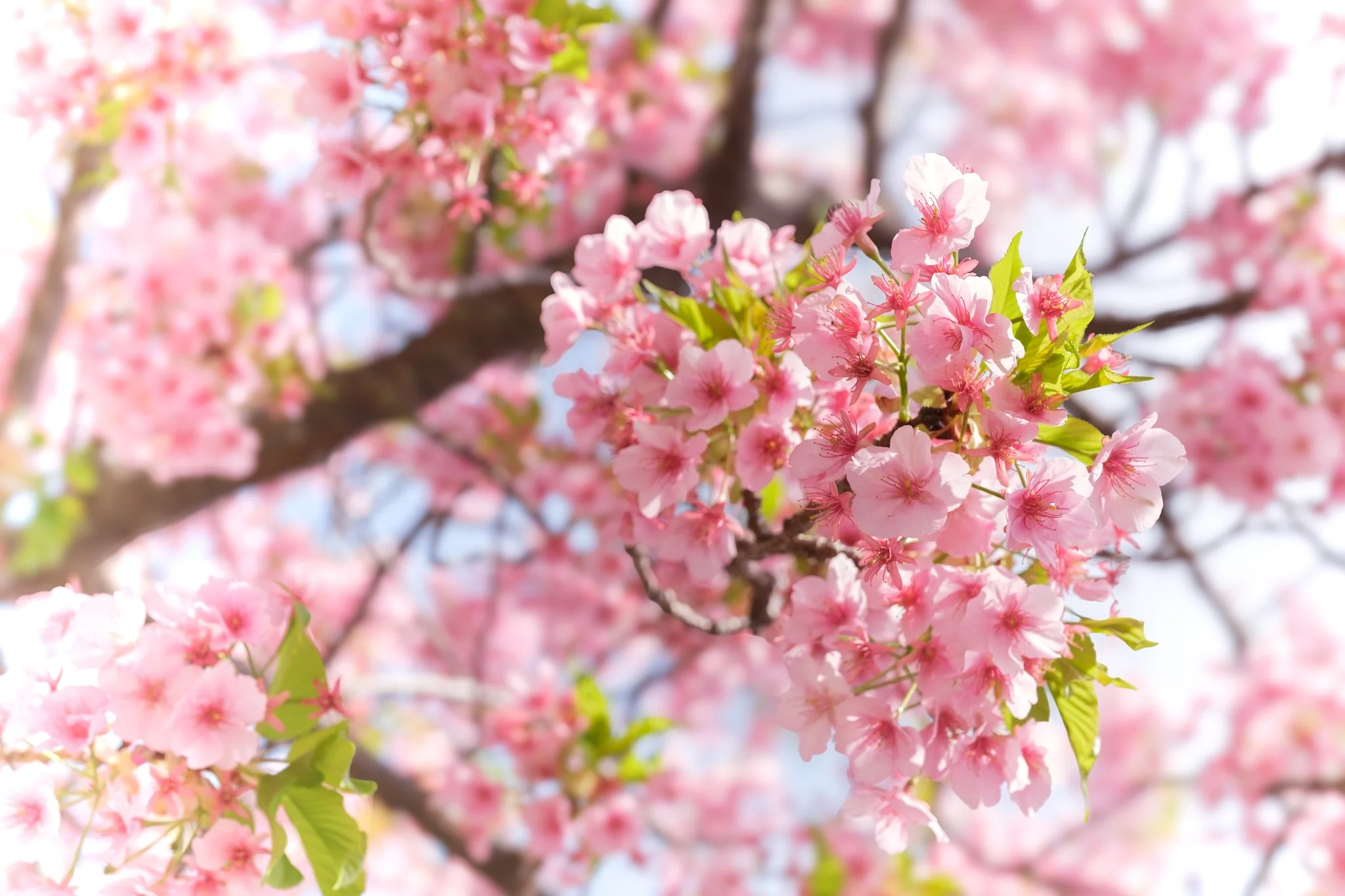
Not a suggestion of pink. Not the pale, apologetic blush of early spring in other places, in other countries. This was pink as a declaration, pink as a weather system, pink as something that had been building for months underground and had chosen this precise morning to arrive all at once. The trees on the right side of the path stood laden — extravagantly, almost aggressively so — their branches so heavy with blossom that the March air itself seemed to feel the reproach of it. And at their feet, running in a long bright seam between the path and the sky, a band of yellow: rapeseed flowers, gold and blazing, as though someone had drawn a line in the earth to separate the pink above from the blue below.
I stopped walking.
Around me, others stopped too — each person briefly suspended in their own private arrest, drawn out of the flow of people by the same sudden force. Then, one by one, they moved on again. Cameras came out. Phones came out. The murmur of recognition, the soft collective exhale of a thousand people seeing something they had come to see and finding, against all expectation, that it exceeded what they had imagined.
I stayed still a little longer than most. In ten years of travel, across a great many countries and a great many seasons, I have learned to hold the first moment of something extraordinary without immediately reaching for a lens. The image will come. But the feeling — the precise, unrepeatable quality of the first second — that goes quickly, and no camera in the world can recover it once it is gone.
Sugoi. The word arrived in Japanese before it arrived in any other language I know. I hadn't planned it. It simply came.
Then I raised the camera. And began.
The Kawazu-sakura is a variety unto itself — discovered here by chance in the 1950s, a single tree noticed by a local resident growing wild along the riverbank. It was transplanted, multiplied, planted in rows along the river until some eight thousand trees now line the banks and streets of this small town on the Izu Peninsula. What distinguishes it from the Somei-Yoshino — that pale, almost translucent variety that most of the world pictures when it thinks of cherry blossom — is immediately apparent to anyone standing beneath it: the petals are larger, and the colour deeper, a pink that carries genuine conviction rather than the Somei-Yoshino's delicate suggestion of it. A pink that does not apologise for itself.
And then there is its most singular quality, the one that perhaps explains the two million visitors it draws each year: where other cherry trees bloom for a week and are done — that famous brevity, that celebrated speed of departure — the Kawazu-sakura holds for nearly a month. It opens slowly, gradually, as though measuring its own generosity. It does not hurry toward its ending. In a tradition that has always elegised the blossom's falling, this tree offers something rarer: time. Time to look. Time to return. Time to bring someone else and look again.
One must understand something about the Japanese and the sakura, to understand why a train platform in a small coastal town fills with people on a mild March morning. The cherry blossom is not merely a flower here. It is a national event, a collective awakening — a signal transmitted simultaneously to sixty million people that something important is beginning. The moment the first bloom is confirmed, tracked and reported with the seriousness of a meteorological emergency, the country responds. Shops fill their windows with sakura-printed fabric. Pink confections appear in every bakery. Convenience stores stock sakura-flavoured everything. Schoolchildren draw them, poets write them, television crews station themselves beneath the earliest trees as though covering a summit of state.
The colour pink migrates from decoration to atmosphere — everywhere, in everything — and the Japanese do not find this excessive, because to them it is not excess but recognition. The annual acknowledgment of something they have known and loved for more than a thousand years.
The sakura is beautiful because it does not stay. This is not incidental to the love — it is the love's very mechanism. A flower that lasted would be merely a pleasant feature of the landscape. A flower that arrives in brief and overwhelming abundance, then releases itself to the wind, demands to be witnessed. It demands presence. And the Japanese, perhaps more honestly than any other people I have encountered, have organised an entire season of their emotional life around the discipline of paying attention to something that will not wait.
The Kawazu-sakura, blooming earlier and longer than all the others, is both oracle and proof — the first evidence of the year that the compact between the Japanese people and their most beloved flower is still, and will always be, honoured.
I crossed onto the northern bank of the river and walked east, camera in one hand, phone in the other.
This is the working rhythm of what I do: the camera for the image that will hopefully one day be a print — large format, high resolution, something that will hold up at a metre wide on a wall, that will carry in its grain and colour the full weight of the moment — and the phone for the footage, for the story told in movement rather than stillness, for the frame that lets a viewer feel the wind and hear the birds and understand, in a way a photograph cannot quite achieve, that this was real and I was fortunate to be there. Each tool sees differently. Each asks different questions of the subject. I switch between them constantly, sometimes mid-thought, following whatever the light and the moment are offering.
The river ran quiet and dark between its banks, maintaining through all this extravagance of blossom the steady indifference of water that has seen many such springs. Eagles turned slow circles in the blue above, regarding the scene below with what appeared to be no particular opinion about it — which struck me as possibly the most sophisticated response available. I walked slowly, stopping often, crouching for one angle, stepping back for another, waiting.
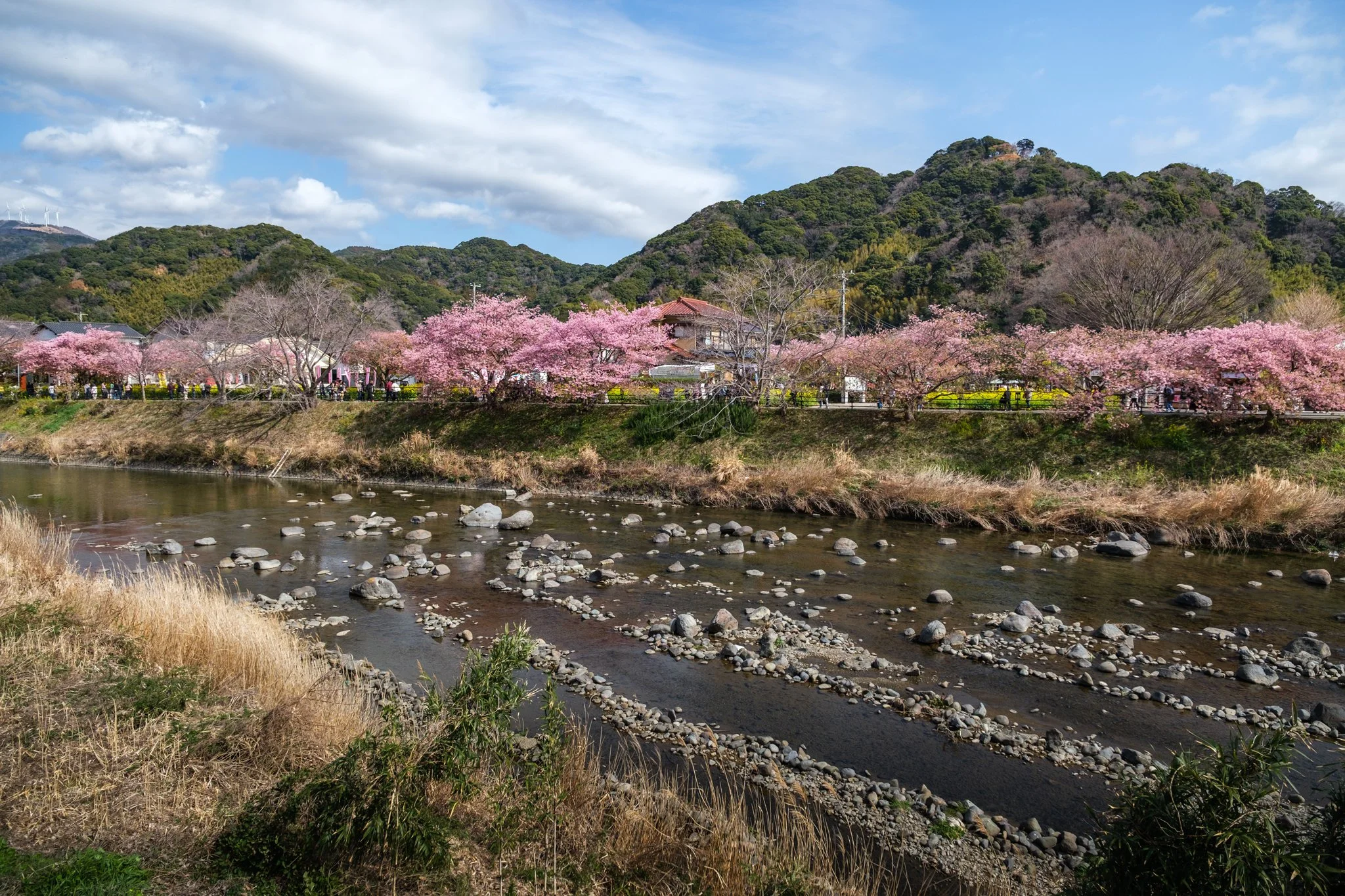
Each cluster of flowers was, on close inspection, entirely unlike the one beside it — a different angle of opening, a different arrangement of petals, a different way of catching or deflecting the light. What appeared from a distance as a uniform canopy of pink resolved, up close, into something far more particular and diverse, each blossom insisting on its own specific character. For a photographer, this is simultaneously the great pleasure and the great difficulty of such a subject. The eye is drawn in every direction at once. I spent an unreasonable amount of time on a single small branch, waiting for the light to shift, or for a bird to settle at precisely the right distance within the frame, its colours in conversation with the pink around it rather than in competition. The rule of thirds, the logic of colour, the geometry of negative space — not constraints but negotiations, conducted in real time with a subject that does not hold still and does not wait. The bird moves. The light changes. One begins again. This is the quiet madness of the craft, and I mean that without complaint.
I thought, standing there with my camera raised and my feet refusing to move on, of languages. Each blossom a word. Each tree a dialect. The same root, the same origin, and yet no two quite saying the same thing — the meaning shifting with the light, with the angle, with the season's particular mood on this particular day. One could spend a lifetime among them and still find, on the next branch, something not yet seen.
I crossed on a small bridge to the opposite bank, and found myself, suddenly, alone.
The great procession continued along the far side — that slow, dense river of visitors moving beneath the sakura in the instinctive formation of people following other people, stretching back to someone who had simply looked in this direction and begun walking. From where I now stood, I watched them with an affection that surprised me and a distance that I was grateful for. They moved as a single softly breathing thing, drifting beneath the pink in a long, unhurried column — peaceful, communal, each person wrapped in their own version of the same quiet wonder.
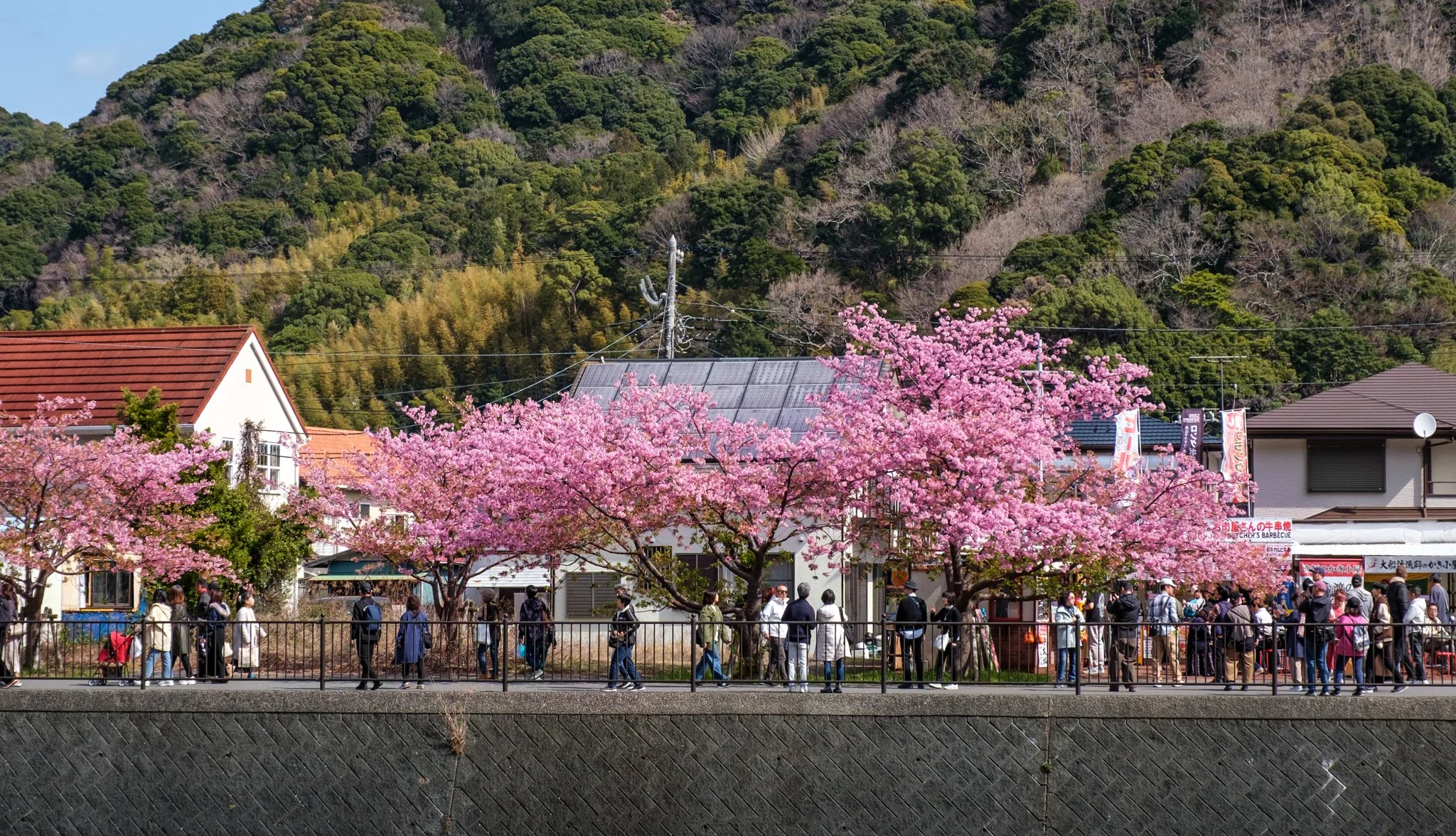
This bank was quieter. The light fell differently here. The silence had a texture — not the silence of emptiness but of things held in suspension, waiting.
The blossoms on these trees were still tight to their branches — not yet prepared, or perhaps not yet willing, to release themselves. The falling of the cherry blossom is so thoroughly enshrined in the aesthetic consciousness of this country that one sometimes forgets the blossoms must first hold on, must first have their period of insistence and attachment. These were insisting. There was something in it I found unexpectedly moving — the quiet stubbornness of beauty that has not yet decided to become mournful.
I walked. I shot. Camera up, phone up, camera down. Crouching at the water's edge for a reflection that almost worked. Waiting at a bend in the path for the light to arrive at the right angle through the branches. Filming a slow pan across the opposite bank where the crowd moved like something dreamed, soft and continuous, beneath their canopy of pink. The eagles overhead. The river below. And on this side, silence, and the work.
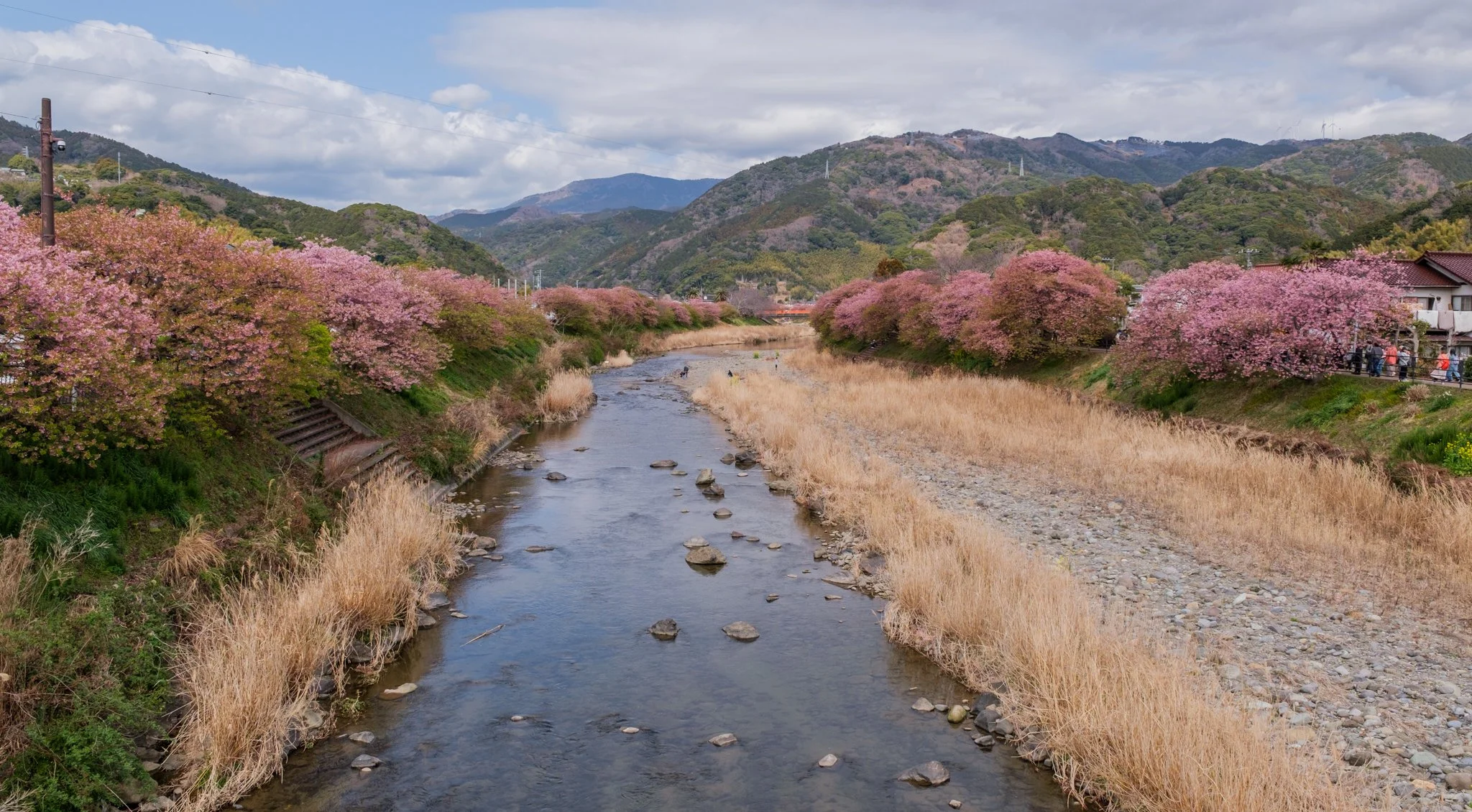
After perhaps an hour, I found a small hot spring at the river's edge.
A modest thing — a shallow basin, a few simple wooden slats, warm water rising from somewhere beneath the logic of the earth. Other travellers were already there, shoes set aside, feet submerged, faces carrying the specific expression of people who have given themselves permission to rest. I sat beside them, removed my shoes and socks, and lowered my feet into the water.
The warmth moved upward through the bones and into the legs, which had been walking without complaint and now, in the heat, quietly abandoned that pretence. I sat. I breathed. I watched the river move past with its customary disregard for the people sitting beside it.
Around me, strangers shared the mild intimacy that physical relief creates — no one speaking much, everyone briefly united by the simple and democratic fact of tired feet in warm water.
Above us, the blossoms were caressed by a light breeze. Somewhere overhead, an eagle — I cannot be certain it was the same one — completed another circle and began another.
Later I stood upon a bridge and looked back along the river.
Both banks lay beneath their continuous canopies of pink, the blossoms reflected in the water below — imperfectly, the image breaking and reforming with each small current, attempting and not quite achieving the original. In the trees, the birds had grown louder as the day matured, moving through the blossoms with an excess of vitality — darting between branches, hovering at flowers with frenetic attention, singing in overlapping and slightly contradictory phrases as though several were composing simultaneously and none willing to defer. Genuinely intoxicated — by the nectar, by the light, by the sheer improbable fact of flowers at the threshold of spring.
One in particular caught my attention — fast, difficult to frame and catch. I shot once, then twice, then several times. Luckily I got the image: beautifully balanced, the bird sitting proudly beside a flower, savouring its nectar like someone enjoying a fine and luxurious drink.
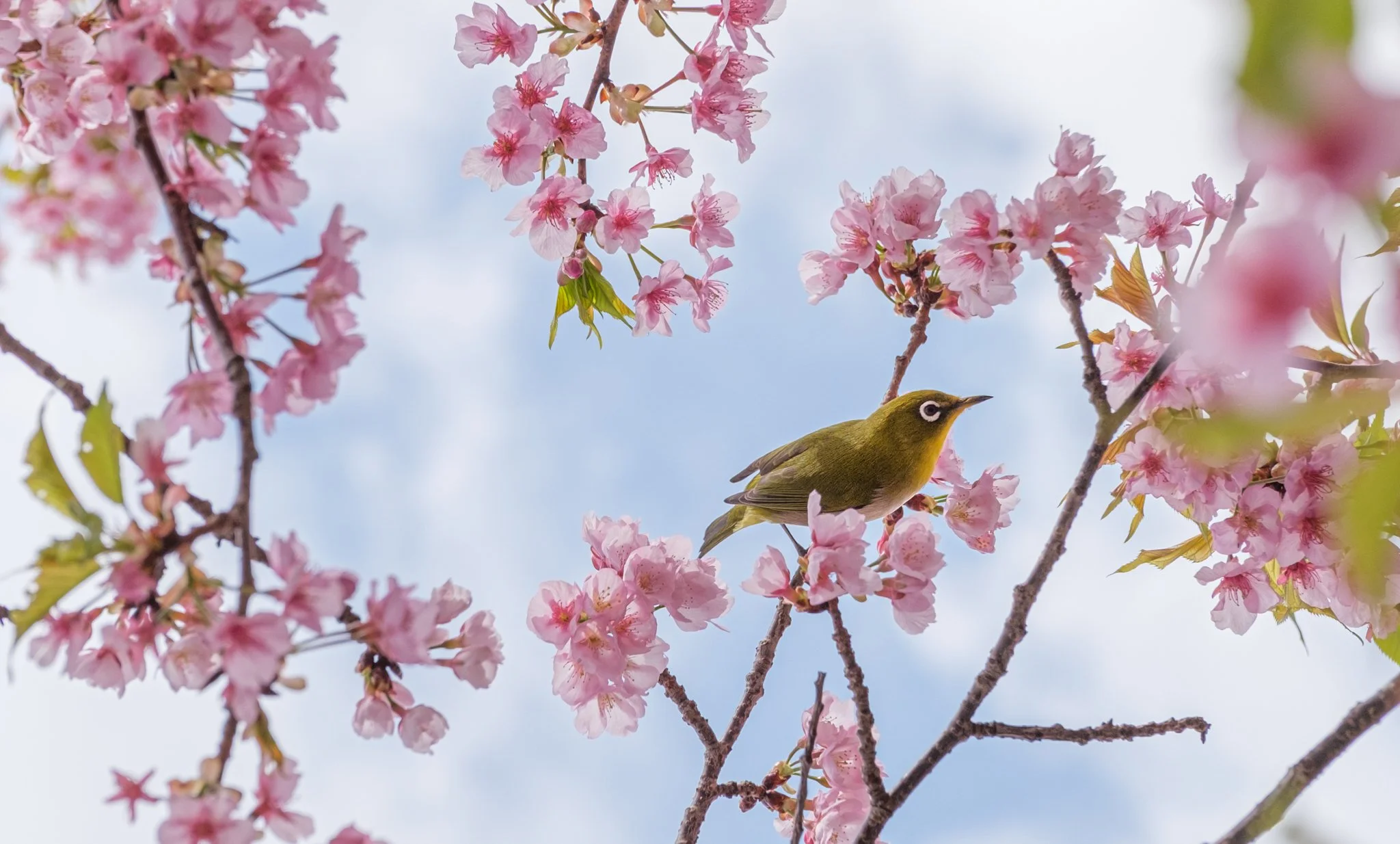
I stood there for a long time. Enjoying the moment, simply but fully.
I found an open stretch of bank where the sky above was unobstructed, and from there I unfolded the drone, ran through the usual pre-flight checks — battery, propellers, camera, weather conditions — the small ritual of preparation that precedes every flight and that I have performed enough times now to do without thinking, though I never do it without attention.
Japan and its rules — licenses, permits, designated zones — a framework as meticulous as everything else the country constructs, and entirely consistent with a society that has understood through long practice that the careful observance of rules is not a constraint on living well but its precondition. The trains run on time here not because the trains are different, but because those operating them and those boarding them share a quiet understanding that precision is a form of mutual respect. One imagines the same principle extending skyward — the airspace as orderly as the pavements below, collisions minimised in all directions, literal and otherwise.
The eagles, presumably, are managing on their own.
And yet even with every formality in order, flying a drone in Japan carries its own social weight — a delicacy that has nothing to do with aviation law and everything to do with the culture's acute sensitivity to the comfort of others.
To impose noise, or intrusion, or even the mere awareness of one's presence upon a stranger is a small but genuine transgression.
I scanned the faces of nearby visitors and chose my moment carefully. The technical permission and the human permission are two entirely different things, and only one of them can be applied for in advance.
I chose my moment. And I sent the drone up.
It rose into the blue with a thin mechanical sound, carrying its camera into the territory of the eagles — slightly curious but unbothered by this strange new bird appearing in their sky — and through the screen I watched the world reorganise itself from above. The river curved through the valley in long unhurried bends, a dark line of water flanked on both sides by the continuous pink of the sakura — not trees now but a texture, a condition of the landscape, two parallel brushstrokes alongside the water's winding course.
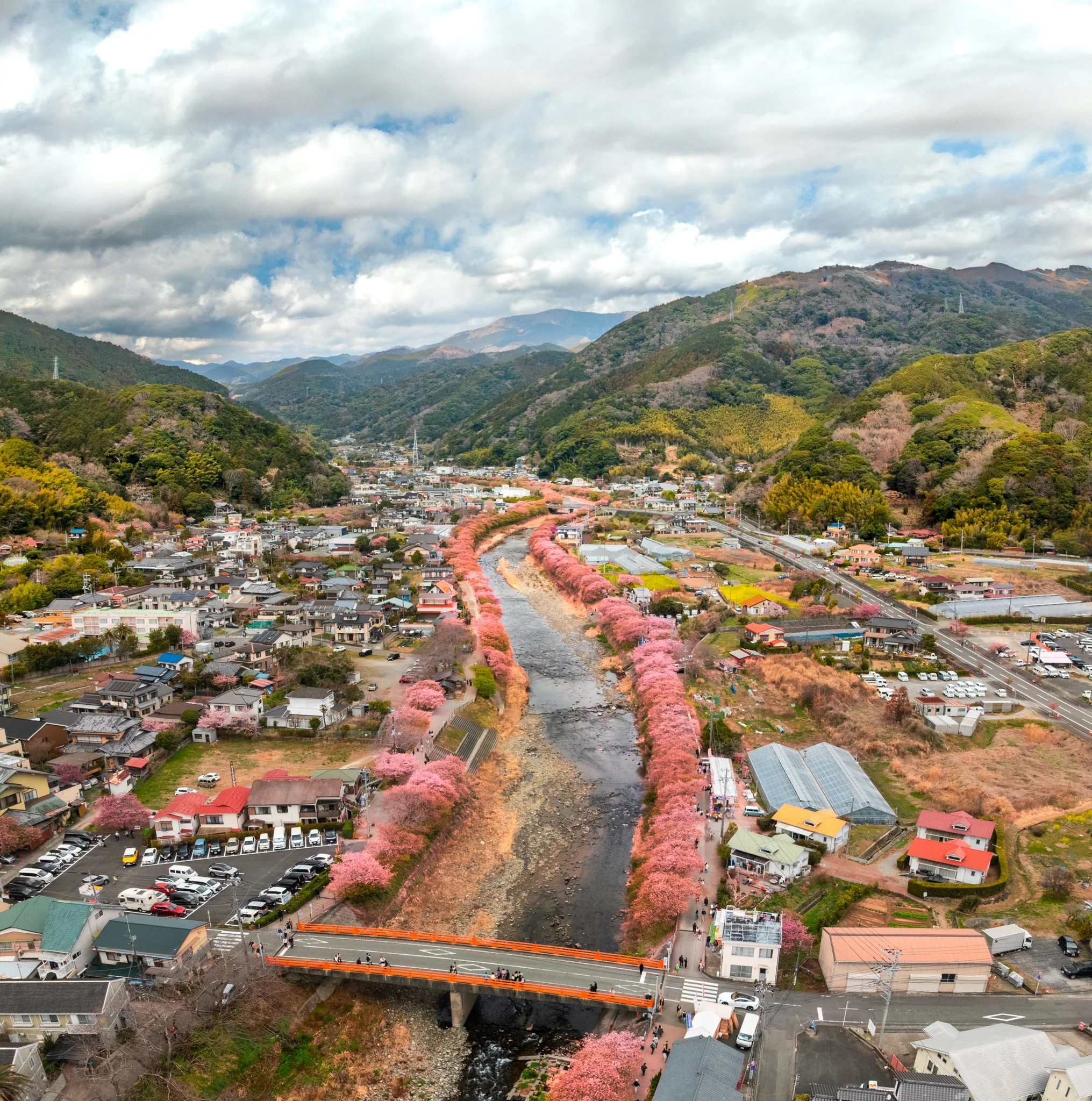
I thought about the eagles. I thought about what it might mean to perceive beauty only from a distance sufficient to make it abstract. I am not sure I arrived at a conclusion.
I descended, retrieved my flying camera, and rejoined the world of the ground, which by now had grown considerably more crowded.
The morning had completed its transformation into afternoon, and the visitors had multiplied in the way of things that attract others by the simple fact of having attracted them already. I moved through it slowly, not with impatience but with the acceptance of someone who has made peace with the pace that is available. I stopped at a stall where a man tended skewers of wagyu over low heat, the fat rendering in a way that was both modest and intensely persuasive, and stood and ate one in the mild air, tasting the particular satisfaction of simple food eaten outdoors in good circumstances.
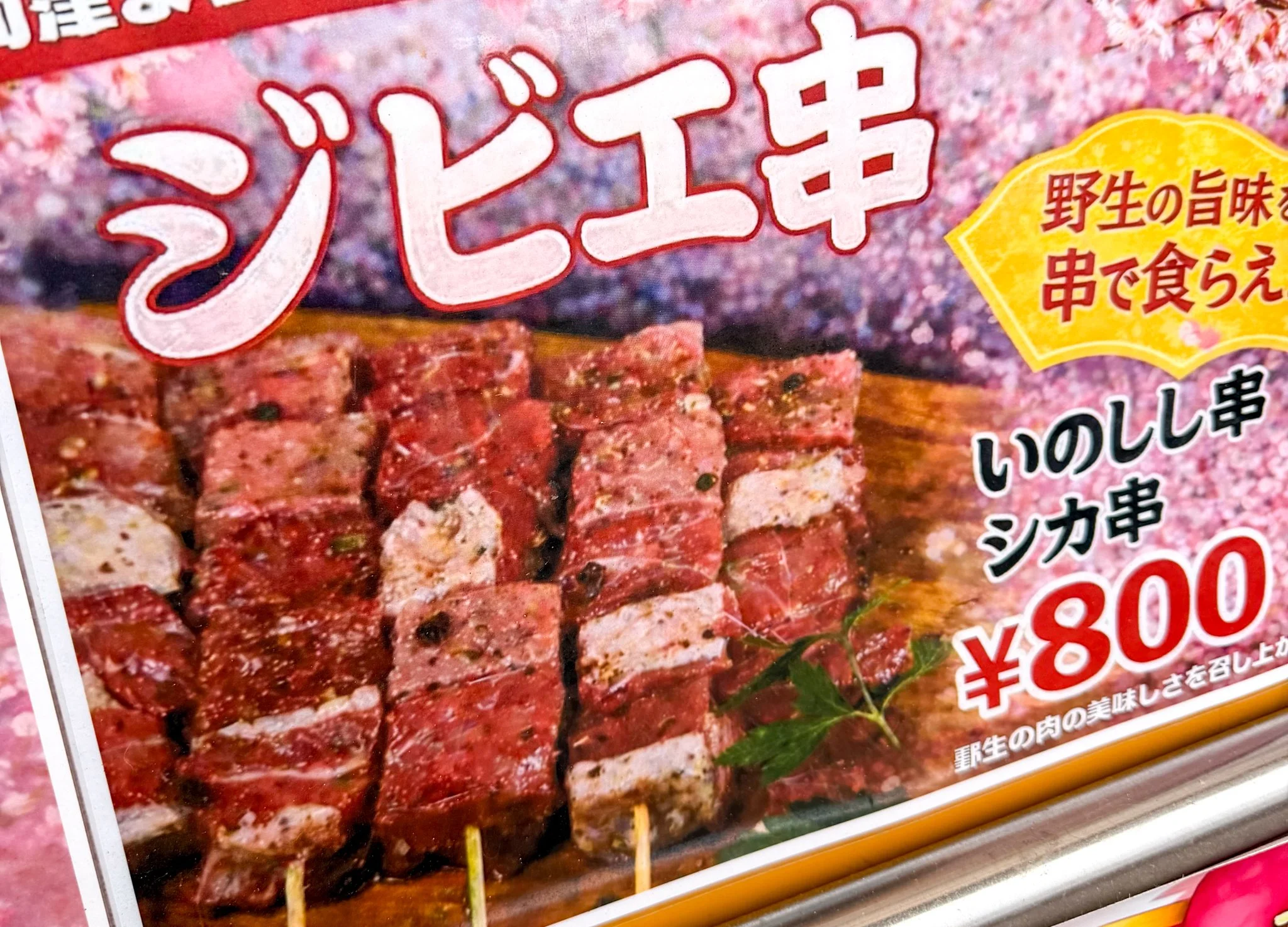
I drank a lemon sour — cold and sharp and entirely correct.
And then, before turning back toward the station, I stopped once more.
The crowd had thickened, the path loud with voices and footsteps, but between the bodies and above the heads — there it was again, unchanged and entirely indifferent to the human commotion below: the blue of the sky, the yellow of the rapeseed along the banks, and the pink. That pink. I raised the camera one last time, finding the frame where all three lived together, right above the flow of people, mesmerised — sky, gold, blossom — the colours that had defined this day from its first light to its last. Blue above. Yellow below. Pink between. A painting the season had composed without asking anyone's permission, and which would last, in this precise form, for perhaps another week before the petals began to fall and the yellow faded and the blue remained alone.
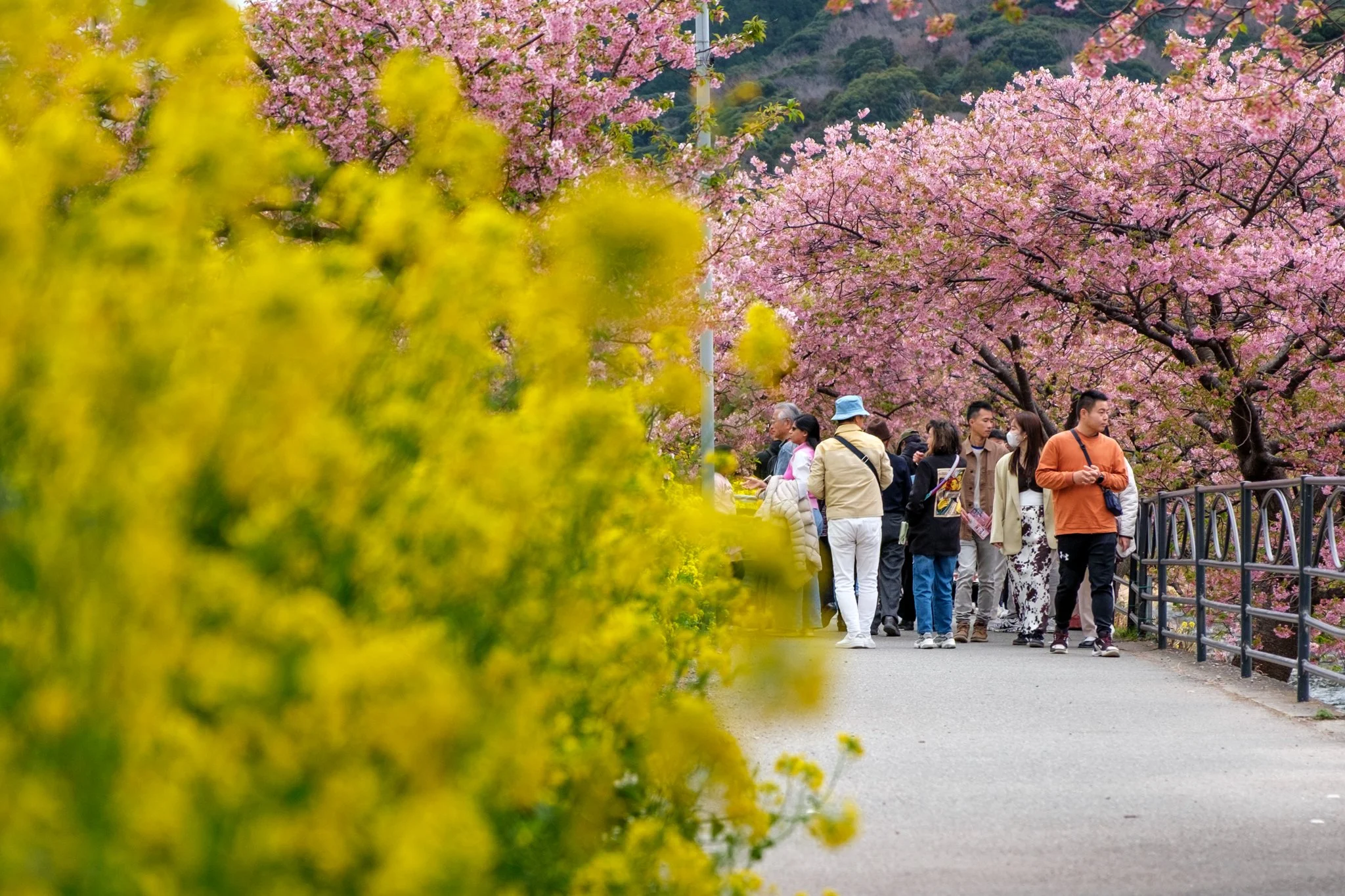
I took the shot. I took several. Then I put the camera away.
The crowd was telling me, gently but firmly, that it was time to leave.
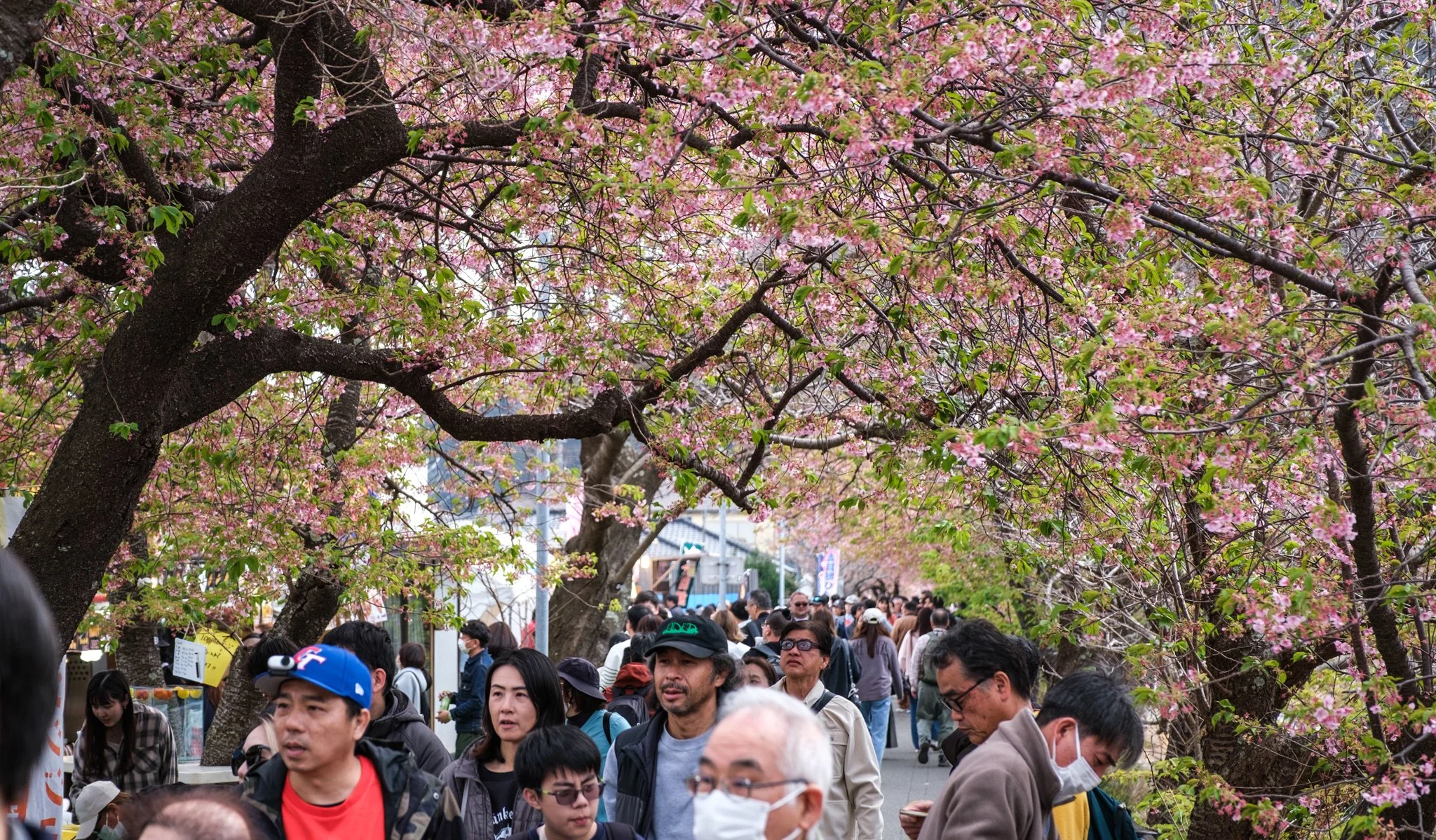
In the late afternoon I turned and walked back to the station.
My legs were heavy in the way of legs that have done what was asked of them and are now simply waiting to be allowed to stop. My backpack — camera, drone, batteries, the accumulated weight of the day's images translated back into the mass of the devices — pressed on my back with the blunt honesty of physical things. But none of it felt like much to complain about.
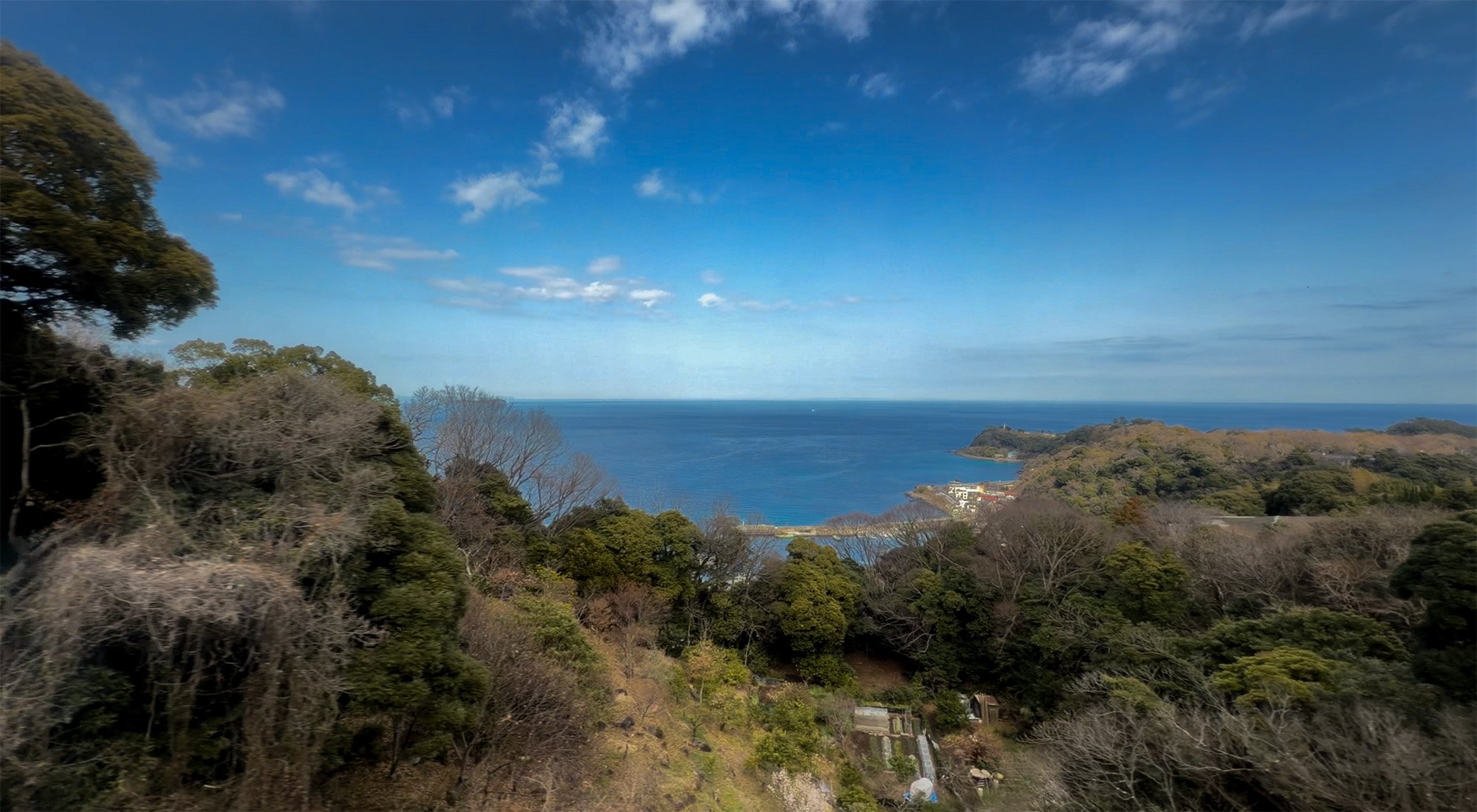
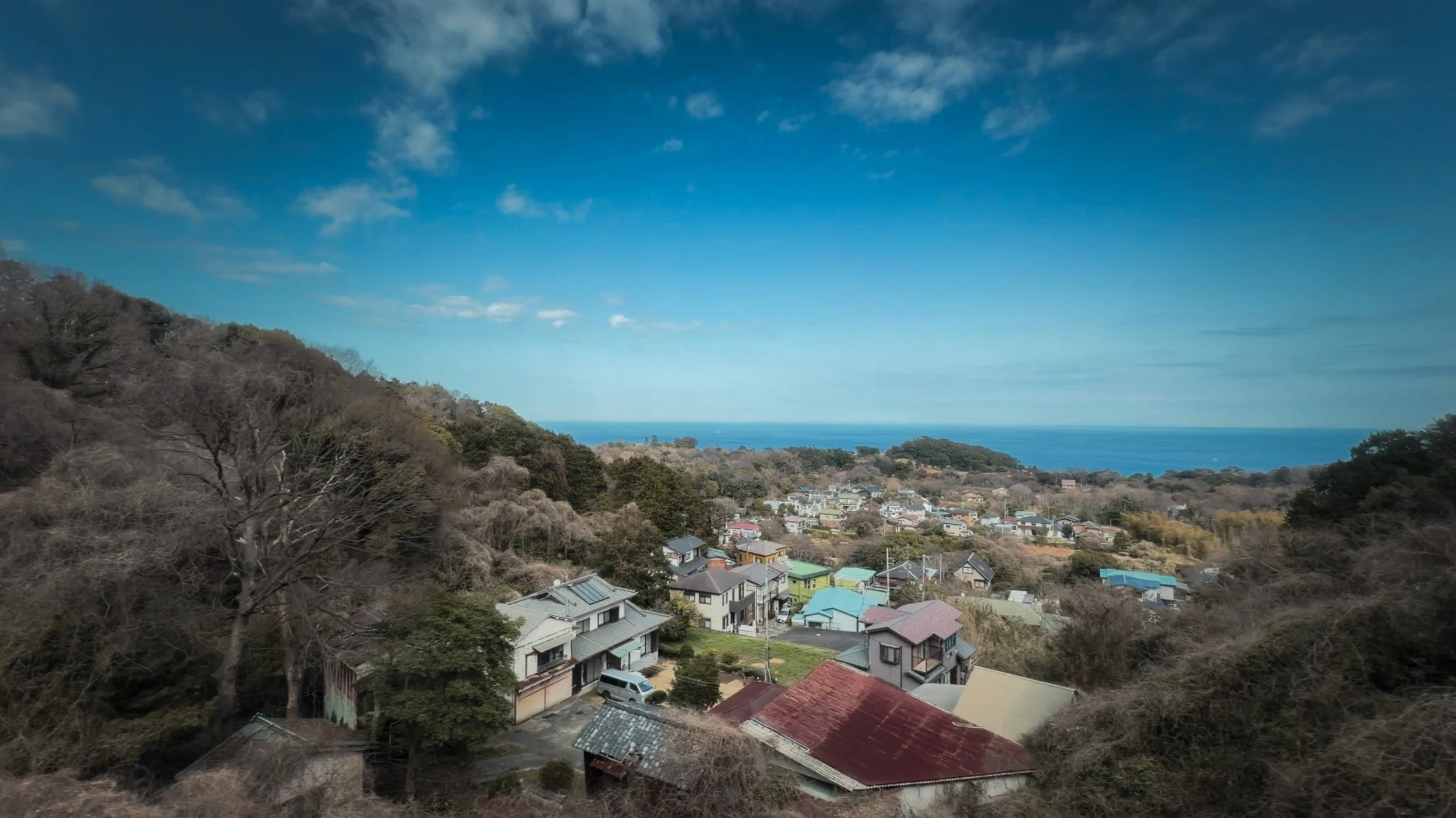
The train back was faster. The coast passed in the window in reverse, the light still holding — that long, golden late-afternoon light of a day that had been warm beyond expectation and seemed reluctant to concede to evening. It was only as the train pulled into Fujisawa that I noticed the sun beginning, at last, to lower itself toward the horizon — not gone, not yet, but tilting, softening, casting the station and the street in amber as I stepped onto the platform. By the time I reached the hotel, the first suggestion of dusk had arrived at the edges of the sky.
I set the pack down. I sat on the corner of my bed.
There is a concept the Japanese name mono no aware — the pathos that attaches to things precisely because they pass, the bittersweet comprehension that beauty and ephemerality are not in opposition but are, in fact, the same phenomenon approached from different angles.
Ten years of travel, time invested in learning languages, hundreds of thousands of images made. Within all of that, there are days one barely recalls — softened, overwritten. And then there are days like this one, which do not soften with the passage of time, as though the mind simply refuses to be careless with them.
Japan does this. It does not reward casual looking. But for those willing to arrive early, to cross to the quieter bank, to lower their feet into the warm water and simply sit — it offers days that lodge themselves permanently in the deepest memories.
Pink. The colour of the day. The colour of the trees and the crowd beneath them and the petals that had not yet fallen and the memory that would not. My favourite colour, worn by an entire valley for one brief and unrepeatable month, as if the landscape had dressed itself precisely for the occasion.
The day was there to stay.
End